

 Image 1 of 1
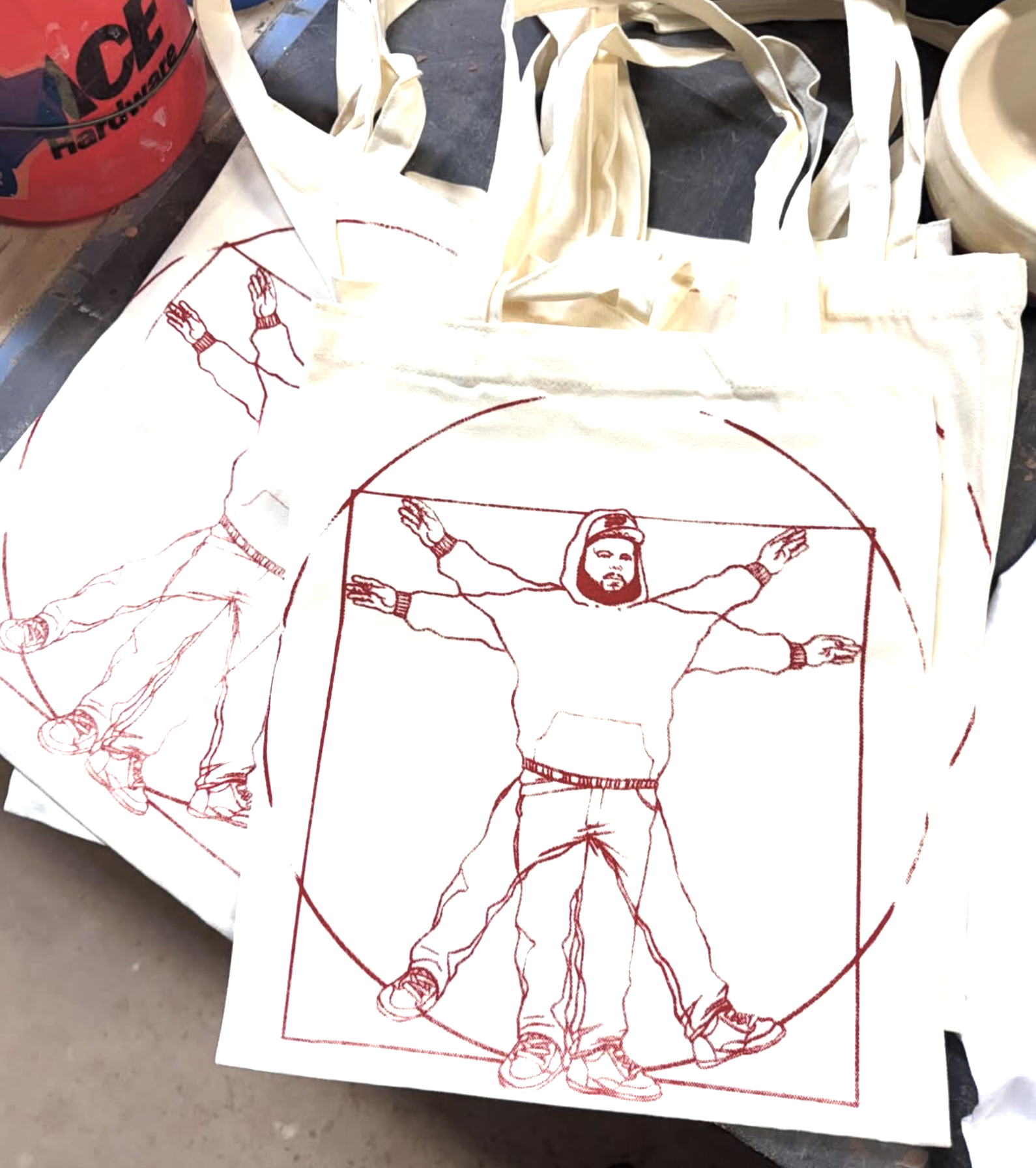
Roberto silkscreened each of these totes with his drawing as himself as the Vitruvian man.
Vitruvian Man (Italian: L'uomo vitruviano) is a drawing by the Italian Renaissance artist and scientist Leonardo da Vinci, dated to c. 1490. Inspired by the Roman architect Vitruvius, it depicts a nude man in two overlapping standing positions, inscribed within a circle and a square. Art historian Carmen C. Bambach described it as "justly ranked among the all-time iconic images of Western civilization".[1] While not the only drawing inspired by Vitruvius, Leonardo's work uniquely combines artistic vision with scientific inquiry and is often considered an archetypal representation of the High Renaissance.
The drawing illustrates Leonardo's study of ideal human proportions, derived from Vitruvius but refined through his own observations, contemporary works, and the treatise De pictura by Leon Battista Alberti.
Roberto silkscreened each of these totes with his drawing as himself as the Vitruvian man.
Vitruvian Man (Italian: L'uomo vitruviano) is a drawing by the Italian Renaissance artist and scientist Leonardo da Vinci, dated to c. 1490. Inspired by the Roman architect Vitruvius, it depicts a nude man in two overlapping standing positions, inscribed within a circle and a square. Art historian Carmen C. Bambach described it as "justly ranked among the all-time iconic images of Western civilization".[1] While not the only drawing inspired by Vitruvius, Leonardo's work uniquely combines artistic vision with scientific inquiry and is often considered an archetypal representation of the High Renaissance.
The drawing illustrates Leonardo's study of ideal human proportions, derived from Vitruvius but refined through his own observations, contemporary works, and the treatise De pictura by Leon Battista Alberti.